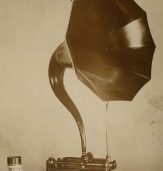
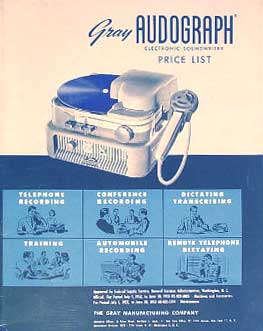
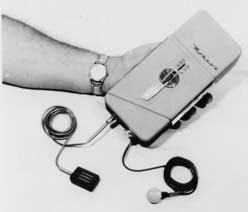
The U.S. market for dictation equipment grew but competition became fierce in the 1950s. Electronics and the new media, particularly magnetic recording, made it possible for companies to offer new kinds of systems. Now, for example, the telephone could be used to “dial up” a central office dictator/transcriber. Typists accessed the machine remotely. Companies selling these central systems convinced their customers that their cost savings made them preferable to buying dictation machines for each user and transcribing machines for each typist.
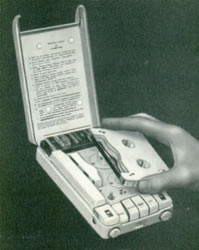
Who bought these things, and why? Dictation equipment manufacturers targeted certain kinds of customers who they knew were likely to produce large amounts of correspondence -the most common use for dictating machines. They created advertisements that glamorized the use of dictating machines and portrayed powerful, successful businessmen at the top of the corporate hierarchy– upper managers and executives. They hoped that if they could convert the executives, the rest of the organization would follow. But it was not easy. Executives as a group often refused to use a dictation machine. Many preferred to dictate to a personal secretary– often a young women. It was a corporate status symbol to have a personal secretary. Unlike other employees, executives also had the power to refuse to use technologies they didn’t like. Others admitted to experiencing anxiety when the machine was recording, or they preferred making notes in longhand and then reading them to their personal secretaries. Dictation machine manufacturers tried to convince them that this was an expensive way to write letters. However, there were some executives who had just the opposite attitude. Further, it was these enthusiastic customers created demand for a new type of business recorder that came along in the 1950s–the miniaturized, portable dictation machine. In a day when “portable electronics” was virtually an unknown concept, the portable tape or wire recorder was, to some, the ultimate stylish business accessory. A dozen or so miniaturized voice recorders appeared in the 1950s and early 1960s. Mohawk Business Machines was one of the pioneers in this market in the early 1950s. However, by this time there were now dictation machines being imported from Germany, Scandinavia, and Japan, like the “Minifon” (above). The introduction of “foreign” machines into the US market was the beginning of the end for American dictation machine manufacturers.